Showing posts with label bookclub. Show all posts

Friday, 3 April 2015

The Year in Books - the first two months

Alas moving house has absorbed all the energy (and some) of the first three months of the year, so I am catching up on the first two months' books in one post, then I will do another post for March and April.  First off is January's book, which was The Country Life Cookery Book by Ambrose Heath, originally published in 1937 and republished last year by Persephone Books.  It is arranged seasonally around the months of the year, each month starting with a wonderful illustration by Eric Ravilious and a short guide to what to do that month in the kitchen garden.  Heath's intended audience seems to be the relatively affluent country-dweller, who relies on what is available in local village shops and in the kitchen garden; and it is assumed that both are well stocked.  With an increasing connection now being made between growing and cooking vegetables, for example in some of the books published by Nigel Slater and programmes such as Kew on a Plate, it is interesting to see a writer ahead of his time in his insistence that there should be a greater link between kitchen and garden.  In arguing for this he draws on the work Vegetable Cookery by a Mrs Elizabeth Lucas, who "offers the revolutionary theory that the gardener should be under the direction of the cook".  While most of us today lack both servants, but his remarks on the vegetables to grow (or buy) and eat are still relevant and useful.  Unlike many gardeners of his day he argues against going for size and large quantities of a few crops, in all things he is driven by taste.  This comes across in his recipes, he writes with almost greedy interest and definite conviction: one of my favourite lines comes at the end of a recipe for an apple pudding, "Bake until the top crust is brown and crisp, and eat it with gratitude."


The second book, for February, is a novel, A Song for Issy Bradley by Carys Brae.  At risk of straying into cliché, I found this hard to put down and was utterly absorbed in its world.  However, it is one of those books that it is hard to review without giving too much away.  In short it deals with the effects of a tragedy on a Mormon family living in the North West of England and observes the events through the eyes of different members of the family in turn.  Throughout the family's faith both helps and hinders their grief and the novel explores the tensions of being a family living by different rules and beliefs to that of the community around them.  I rarely read modern fiction, generally having too much of the back catalogue to get through, but heard the short story the novel started off life as on the radio and needed to read the rest of the story.  It is beautifully written, cathartic (I did a fair amount of weeping), but not mawkish or depressing, do read it.

As ever you can see the other entries in The Year in Books here

Friday, 19 December 2014

The Year in Books December

Naturally my book for this month is Christmassy, how could it not be?  I am not sure how I stumbled across Christmas with the Savages by Mary Clive, but it is exactly the sort of book I would have adored as a child, gentle, funny and giving a window on the past.  It is an account of a child's Christmas in a big country house at the turn of the twentieth century, observed with a quiet humour and that rare ability to remember how things feel and look to a child.

Mary Clive photographed by Cecil Beaton at around the time Christmas with the Savages was published. Image National Portrait Gallery Collection
Mary Clive was one of the sisters of the social campaigner Lord Longford and was recalling her own childhood Christmases in the book.  Her life seems to have been heavily overshadowed by the two world wars, in the first her father was killed, devastating her mother and her husband died in the second.  Despite this she seems to have been a woman of great spirit and I would love to read her account of life as a debutante and her autobiography.  The illustrations are lovely and truly deserve printing on better paper to make the most of them.  Definitely a book worth reading.


I also thought, as it was Christmas, that I would share a few of my favourite Christmas books, first those for children and then those for adults.  However, there is no reason why the adults should not read the children's books, why should they get all the fun?

Picture books
The Snowman, Raymond Briggs - I read and watch this every Christmas, essential, see also his Father Christmas
Mog's Christmas, Judith Kerr - Mog gets scared of the walking, talking Christmas tree
Lucy and Tom's Christmas, Shirley Hughes - a gentle, London Christmas, I also want to read Alfie's Christmas and The Christmas Ghost
A Christmas Story, Brian Wildsmith - lovely retelling of the nativity story with pictures reminiscent of medieval manuscripts
The Jolly Christmas Postman, by Allan and Janet Ahlberg - packed with little surprises and wonderful illustrations

For older children
I love Noel Streatfield's descriptions of Christmas in books like Ballet Shoes* and Gemma, if you can get hold of it second hand she did an anthology, The Christmas Holiday Book, which is well worth looking for.
Likewise the Christmas in Little Women by L M Alcott is very special.
Just William At Christmas, Richmal Crompton - hilarious, I dip into this every year.


Adults
A Christmas Carol, Charles Dickens - I'm not particularly a Dickens fan, but this is a gem and even if you feel you know the book from the numerous versions of it, it's well worth reading the original.  The descriptions of Victorian London at Christmas are wonderful.
Christmas Pudding, Nancy Mitford - very funny as she always is
The Everyman Book of Christmas Stories - a lovely collection and beautifully produced book
The Virago Christmas Book - a mix of writing about Christmas, not all soft and fluffy
Treasure on Earth, Phyllis Sandeman - out of print, but still available, autobiographical account of  an Edwardian Christmas at Lyme Park in Cheshire.  It is a delight and makes a nice companion to the Mary Clive book.

Finally, I would love to read Michael Morpurgo's Christmas stories, am hoping for P L Travers' recently re-released Aunt Sass and this year also plan to read Dylan Thomas' A Child's Christmas in Wales, as well as re-acquainting myself with the Paddington Christmas stories in the free copy of More About Paddington that came with the Radio Times.  While researching this I did find that Penguin have released a lovely looking collection of Christmas classics including Anthony Trollope's Christmas stories.

You have probably realised by now that I love Christmas books, what are your favourites?


I have thoroughly enjoyed The Year in Books series by Circle of Pine Trees, you can see the other December entries here.  I look forward to seeing what she suggests for 2015, certainly I shall continue to write about books, I do enjoy it.

*Try to get an edition with the original illustrations by Noel Streatfeild's older sister Ruth Gervis, which Streatfeild apparently felt had captured the book perfectly.  With such a perfect partnership between author and illustrator it seems a pity to me ever to change them, it would be like publishing Roald Dahl without Quentin Blake's illustrations.

Friday, 28 November 2014

The Year in Books: November

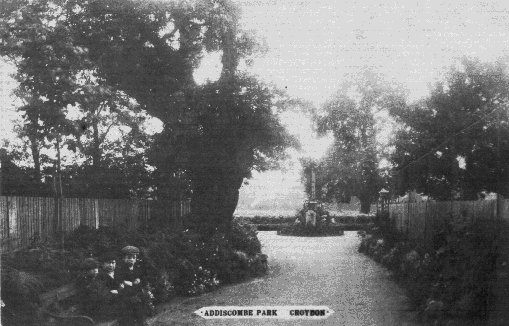
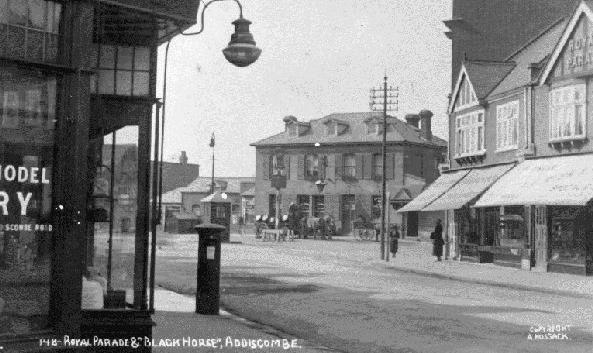
This month's book, The Dreaming Suburb by R F Delderfield, is one set locally to wear I live, which is always a matter of great curiosity, to see a place one knows at a different time and through different eyes.  The novel is set at the far edge of Addiscombe, about a mile and a half east of central Croydon, then the far edge of London, where a street of suburban houses hit the countryside.  Although sadly and predictably swathes of suburbs have covered much of that countryside since.  The action opens as the First World War finished and followed various residents of the avenue through to the beginning of the second war, via the vicissitudes of the intervening years.

R F Delderfield
Delderfield writes in defence of the suburbs, already by the 1940s (when he wrote the book) denigrated, arguing that residents of suburbs have dreams and worries, hopes and fears, just as a city or country dweller has.  It is clear that he enjoyed his time living in Addiscombe as a child and that he retained vivid memories of the place.  He has changed very little about his descriptions, depicting Addiscombe almost exactly as she was and is, almost street by street.

"The Rec" 1918
This is not a great work of literature but it is a pleasant, relaxing and engaging read: the characters are engaging and "real" and he is skillful at weaving a story through their various lives and the events that surround them.  Throughout there is a definite sense of how people react in their various ways to the history that surrounds them, in this case things like the General Strike and the Munich crisis.  The change in the suburb is charted too as the great houses decay and streets of terraces fill their grounds.

"The Lower Road"
Croydon as a whole has a bad reputation and a low self esteem (if one can say that of a place?) these days and so it is lovely to see a time in her past when this was not so.  A lot of these problems have come about from appalling decisions made in the second half of the twentieth century and which continue today.  But Croydon does have a proud past and we should celebrate it more, from the Old Palace, regularly visited by kings and queens, especially Elizabeth I, to the college of the East India Company and the world's first international airport, which saw Amy Johnson return from her solo flight to Australia.  Croydon has other literary claims to fame, for example, at the time that Delderfield lived in Addiscombe, D H Lawrence was living a few streets away, teaching at a nearby school and beginning his literary career and in the previous century Arthur Conan Doyle had lived a few miles away in South Norwood.

But to get back to The Dreaming Suburb, I would recommend it as a gentle, well written book, which captures a time in our life as a nation through the lens of an ordinary street of ordinary people, a perspective different to most histories.

Photographs of Addiscombe past from here

To see the other entries in The Year in Books click here

Monday, 29 September 2014

The Year in Books: September

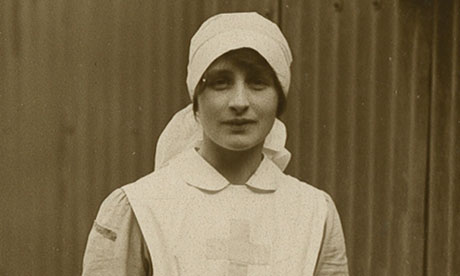
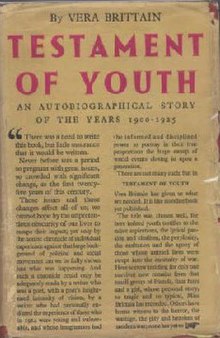
During the commemorations for the centenary of the First World War last month I decided that I should re-read Vera Brittain's memoir Testament of Youth sooner rather than later.  There was, of course, the usual trepidation one feels when approaching a book one first read as a teenager, but I am happy to say that it has more than held up to my memory of it as a magnificent book.  Vera Brittain left Somerville College, Oxford after one year to serve as a Voluntary Aid Detachment nurse (or VAD) during the war and the book covers her life from her birth in 1893 until 1925, when she married.  Testament of Youth is particularly valuable in giving an impression of the state of mind of the British in the run up to the war, throwing some light on why it was such a cataclysmic event and so very shattering to those who lived through it.


The first clue to this is given in the preface written by her daughter, the politician Shirley Williams, who writes that one reason we are so haunted by the war is, "the total imbalance between the causes for which the war was fought on both sides, as against the scale of the human sacrifice".  Brittain's account of the parts of the line, in the early part of the war, where neither side could see the point in killing one another and so had a small voluntary truce, shooting into the air and no man's land, is just one illustration of this point.  Why this war in particular has caught our collective imagination and is such an important part of our collective story is a question I have often pondered.  Our collective remembrance of war is still, a century on, so strongly shaped by the First World War, with our Remembrance Day poppies and our misty-eyed reading of Rupert Brooke and "age shall not weary them".


Brittain's book is a true help to understanding this question, by providing a solid pre-war background she is able to show how shattering the war was to her generation.  There seems to have been a deep complacency and belief in progress, running alongside a belief in the spiritual good of war, testing us and even (in a way that would seem shocking to a post-1945 audience) purging the population.  Brittain's account of attending speech day at her brother's public school in July 1914, with its military manoeuvres, shows the incredible militarism of the pre-war public schools, whence came most of the politicians and leaders of Britain.  The Arnoldian* curriculum of Officer Training Corps, sport and extensive study of Classics** lent itself to a romanticised, spiritual view of war; it is after all a small leap from the Pass at Thermoplyae to the poetry of the early part of the war.  However, these ideals failed to live up to the realities of trench warfare where death came at random from a shower of shells and bullets, killing indiscriminately the strong with the weak.

Testament of Youth has more than lived up to my teenage memories, it is an epic read, but not only is it worth reading, it is engrossing, so that you do not realise that you have somehow read a hundred, or two hundred pages.  According to the biography of Brittain at the beginning of Testament of a Generation (a collection of her and Winifred Holtby's journalism) she found the book extremely hard to write, but I am immensely glad she persevered.  I cannot recommend this book enough, do go and read it, it will enrich your understanding of the First World War immeasurably, but you will also spend time in splendid company.


Incidentally, reading Testament of Youth alongside Testament of a Generation has provided an interesting counter-point and each has cast some light on the other.  Aside from the impression that feminism has not advanced that far from the 1920s and that in politics little changes, each book has provided flashes of insight that have illuminated aspects of one another.  I was particularly interested to read an article discussing, in 1929, calls for the abolition of Remembrance Sunday, some apparently feeling that 11 years was quite sufficient to have remembered the war.  Likewise her horror at finding her children's nanny fixing a poppy on baby Shirley's cot for Remembrance Day throws light upon the gulf Brittain felt between her generation and the one that followed it; for her the poppy was a symbol of war and grief, but for her young nanny it was another "flag day" like any other.

You can see the rest of The Year in Books entries here

*Dr Arnold of Rugby School, whose reforms set the pattern for public schools in the 19th century and whose influence is still felt today, cf. Tom Brown's School Days
**Many of the texts studied were decidedly martial in flavour such as Homer, Thucydides and Caesar

Sunday, 29 June 2014

The Year in Books: June

This month's choice was something of an epic, The Golden Notebook by Doris Lessing, I listened to all 27 or so hours of it on audio book in May and June.  However, at no point was listening a slog, rather like a long, enjoyable journey; Juliet Stevenson's brilliant reading was a vital part of the experience.  The story concerns Anna, a divorced writer of a best selling novel in her 30s living in London with her daughter and covers a period of time from the 1930s to the 1950s.  In its structure it is far from a "normal" novel though, it moves fluidly through time and through different narrative perspectives and is a master class in plot and potentially unreliable narration.  The facts of who is who, or why or how particular things have happened are not spelt out, instead the reader is left to put the pieces of the jigsaw together.  Although this sounds as though it could be infuriating, I found that it actually meant that I thought a lot about the novel as I went along and tried to fit the pieces together, some you are never openly told but are simply expected to put together.  You are quite simply plunged into Anna's world.


The Golden Notebook is very much a novel of the inner life and is mostly told through a first person narrative, except when Anna is looking at the content of the notebooks into which she has attempted to divide up the various strands of her life.  One of these is a third person account of her time in Africa during the second world war and her experiences involved with the Communist party there, for this section of the book Anna gives herself a new name, Ella and also renames most of the other protagonists of the novel.  Hence Lessing is able to leave you unsure how accurate this account of the past is, as Anna tries to create a distance between herself and her past and to examine it in a new way and try out new scenarios - Ella has a son, whereas Anna has a daughter for example.

Relationships and sex play a large part in the novel, as Anna and her friend Molly seek to find a new way to live as single women, a process which seems to result in a lot of unsatisfactory affairs, generally with married men, who seem to see them as available.  In this respect Doris Lessing gives a very different perspective on the life of the unmarried woman in 1950s London to that of another of my favourite novelists, Barbara Pym, whose women are solidly respectable, generally engaged in unrequited love, the church and lonely meals for one in small flats.  Anna's life seems to demonstrate the beginnings of the women's liberation movement of the 1960s, its foundations, while Barbara Pym documents the last of a fast fading world.  Maternity becomes another key theme as Anna brings up her daughter, a very conventional young girl and Molly struggles with her son and what he should do with his life.  Molly's former husband Richard, who had a brief involvement in Communism, but has now settled down to business, represents conventionality and money and Tommy, their son, seems caught in between their two ways of life.  Furthermore one gets the impression from The Golden Notebook that it is not only the women who are struggling to sort out their relationships but the men too, such as Molly's ex-husband Richard, who moves from his second to third wives as the novel progresses.

Anna and her friends are experimenting in new ways of living, not just in terms of relationships but in everything; the Communist Party, in which many of the characters have been or are involved in, is a part of this search.  In the earlier, African part of the novel, Anna and her friends are frenetically engaged with the Communist Party and taking on some of the racism of the British rule.  While later on the novel illuminated the impact of the USSR upon the wider Communist Party, in particular showing the impact of Stalin's death and the revelations of atrocity that followed it on communists outside Russia; for many it seemed to destroy their faith in communism.  At the same time Anna comes into contact with Americans exiled because of the MacCarthy era in American politics; injustice in its various forms is a great concern of the novel.


Therefore, amid this tumult of ideas and identities, it may come as little surprise that mental health is another important strand of the novel, both for Anna and for those around her.  As I had been thinking a fair amount about identity myself before beginning this novel I did find it fascinating; there were a number of those moments of recognition when a novel describes a thought, a feeling, a sensation and you realise that you are not alone in what you feel.  Doris Lessing's descriptions of Anna's sessions with her therapist and of her time of disintegration, are vivid and the latter time becomes immersive, drawing you into Anna's world, it is powerful writing.  While Anna's notebooks, culminating in the final golden notebook of the title, are her way of working out her own identity and what she should do next, having published this successful novel and had a long, ultimately unsuccessful affair.

I have written all this and yet hardly touched on the themes, ideas and people of this novel, nor done the novel remote justice.  The Golden Notebook has to be one of the most thought provoking, absorbing books I have read in years and although its length may seem daunting at first I would recommend making the effort.  As time went on I found that I could lose hours to the book and that I became deeply engaged with what happened to Anna and loved the "Londonness" of the book - certain writers capture London so well.  While doing a little research to write this I have found The Golden Notebook Project, a website containing the novel and the debate a number of female writers are carrying on in the margins, with space for further debate in a forum, which might be an interesting way of reading it.  Lessing's own preface is on there too, although I am glad that I had not read it before I tackled the book, I prefer to make my own impressions, then read the introduction or preface to novels.  The audio book I listened to is available for download here - it is very much cheaper if you join Audible and buy some credits - and I very much recommend the reading, an excellent option for knitters or other crafters.

Perhaps this coming month I will read something that does not concern feminism?

All the other posts from A Year in Books can be viewed here

Wednesday, 30 April 2014

The year in books: April

Squeezing in with only hours of April left to go, I'm so very organised.  This month's book was The Odd Women by George Gissing, which I downloaded from Project Gutenberg.  Published in 1893 it is what you might describe as a progressive novel about the place of women in society, particularly the middle class women who did not marry.  These women were often left in penury with teaching or being a governess the only respectable options for employment, professions for which they were often little suited because they had little education.  Gissing took his title from the population statistics which showed there were around 900,000 more women than men, so inevitably there were going to be an excess of unmarried women.  He uses the novel to rail against the poor education and opportunities available to unmarried middle class women and to argue that all women should be brought up and educated so that they could have a career meaning that if they married they would be better wives and if they did not they would have a means of supporting themselves.  The typewriter is seen as one means of freeing these women from low paid, uncongenial work and two of the main characters are unmarried ladies pioneering the life that is available to unmarried women and training other women in office work.  They appear to see their mission in a similar manner to those rescuing women from prostitution and I think Gissing is suggesting that it is as important a mission.


On the whole this is a rigorous novel of ideas, vividly debated between its protagonists and demonstrated through the lives of the various characters, not one of whom is free of what George Orwell calls "self-torture that goes by the name of respectability".  However, some of the more emotional passages seem rather overblown to modern eyes and are very much of their period, but this does not detract from the interest of the novel and its ideas.  Gissing's view of marriage, as something to be avoided is surprisingly radical for the period and he also discusses ideas of free and equal unions between men and women instead of conventional marriage, something along the lines of "common law marriage" or today's co-habitation.  To some extent this reflects George Gissing's own complicated personal life.

Lithograph of George Gissing by Sir William Rothenstein, 1897

My reading lately has been of books that address this theme of a woman's place and the place of "respectable" unmarried women in society and their poverty, it is one that preoccupies many novelists at least from Jane Austen onwards (although I am sure it predates her) and right on into the 1950s when Doris Lessing's The Golden Notebook, which I have only just started, appears to be asking what place do unmarried women have in society.  In between I have read a short novel by E M Delafield, Thank Heaven Fasting, about a débutante of the Edwardian period who "could never, looking backwards, remember a time when she had not known that a woman's failure or success in life depended entirely upon whether or not she succeeded in getting a husband".  This novel showed a society in which a woman only had a status in relation to a man, a daughter, a fiancée, a wife, a mother, a widow and of these "wife" was far and above the most important status.  The débutante is treated as a child and her mother's emotional collapse upon her father's death shows how far her status is affected.

Anyhow, I shall continue with my feminist reading into May and continue through The Golden Notebook, which I have on an audio-book, making it ideal for listening to while knitting.  Perhaps that will be next month's book and perhaps I shall write about it before the evening of the last day of the month!

Wednesday, 26 March 2014

The year in books: March

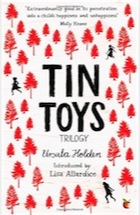
Yet again I have let the month almost slip through my fingers and get away without me having written about this month's book, or rather books, as this month's book is truly a trilogy, although made up of comparatively short books.  Ursula Holden's The Tin Toys trilogy, consisting of The Tin Toys, Unicorn Sisters and A Bubble Garden.  Like Penelope Fitzgerald, Ursula Holden began writing comparatively late in life, after attending a creative writing class in her late forties.  The novels are about three sisters growing up in England and Ireland around the time of the second world war.  Each novel is narrated from the perspective of a different sister, providing fresh insights and perspectives on the girls' joint past and uncovers what each knows about the others.


I bought this on a whim, as I had a dentist's appointment coming up and our dentist always runs late, making a good book a must for the waiting room, and I must admit I had vaguely expected something a little cosier.  Whereas these books are far from cosy, they make up a tale of neglect, of children pushed from pillar to post and considered an inconvenience by their mother who would rather follow her own path.  I get the impression that the children's mother feels that as her husband has died and thereby deserted the family, she is entitled to go too.  So the children move from one unsuitable place to another and endeavour to bring themselves up, searching for love and trying to make a home wherever they end up.  Holden evokes places as they seem to a child well, making her places atmospheric and her people real, with all their flaws. In many ways the adults around these sisters are every bit as lost, damaged and vulnerable as the children and just as unable to find their way through a changing world.  For a key theme of the novels is that of class and the impact the second world war had on the lifestyle of the upper classes.  In this new world it is the lower classes who thrive, while the upper classes struggle to adapt and are without suitable resources.

Ursula Holden photographed by Fay Godwin in the 1970s

In many ways I was reminded of Noel Streatfeild's wartime novel for adults Saplings, which deals with similar themes of neglect and the way children could be pushed from pillar to post during wartime.  Both novels do much to dispel the sometimes cosy image we get of the second world war; there is no cheery Blitz spirit to be found.  Other novels exploring similar themes include Streatfeild's first novel The Whicharts (later re-written as Ballet Shoes) and Eleanor Graham's The Children Who Lived in a Barn.  While Marghanita Laski's novel The Village explores similar themes of the war's impact on society.

In summary I would recommend The Tin Toys Trilogy most heartily; I read it in great gulps, riveted and wholly inhabiting their world and will have to go back and re-read it, hopefully more slowly.  Although I am currently attempting that with Rebecca West's magical novel The Fountain Overflows and for all my good intentions I get too drawn in to go slowly and instead read it in great deep draughts.  Do you find you have the same problem with some novels?

Virago have republished The Tin Toys as a Modern Classic and I sincerely hope that they republish more of her books soon.  Here you can hear a short interview  with Ursula Holden, who is in her nineties and living in a convent nursing home in West London.

Tuesday, 25 February 2014

The Year in Books: February

Before we run out of February here is my book for the month: An Omelette and a Glass of Wine, a compilation of the journalism of Elizabeth David.  I adore reading Elizabeth David's cookery writing, she wrote as well as she cooked, so that her pieces are pithy, inspiring and taste good to read, odd though that statement sounds.  She had a real skill in recalling a place and a time, so that as she travels you walk through markets, taste, smell and eat with her.  If she did not like something, a restaurant, or the sample tinned pies sent by publicity departments with an optimism born of lunacy, or the British practise of taking other countries' dishes and bastardising them, she could be devastating.  In the case of one restaurant she adds in an after-note that sometime after the publication of her piece the restaurant had lost its Michelin star!


The pieces are a whole mixture and show the sheer variation that can be achieved when writing about food, there are short biographies of key figures like Mrs Beeton and Marcel Boulestin, an account of the invention of tinned tomatoes, numerous wonderful travel pieces (she would have made a good travel writer), various aspects of the history of food are covered, as well as the more usual pieces containing recipes.  I cannot recommend this book enough, her writing is a joy and her passion for good food, properly made, is inspiring.

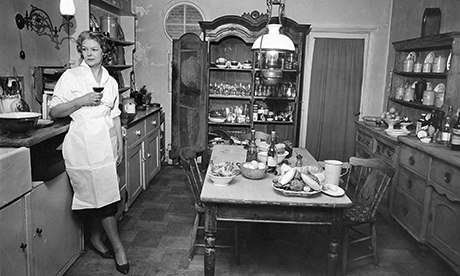
I would love a kitchen like this

Elizabeth David began writing on her return from Egypt in 1946, where she had been working during the war, because she missed the food of the Mediterranean and the sunshine.  When her first book, A Book of Mediterranean Food, was published in 1950 food was still rationed and many of the ingredients were largely unobtainable, except sometimes in small shops in Soho, but the book was wonderfully aspirational, a reminder that food could be something more than a problem to be solved.  She went on to write a number of books on European food, which were followed by a few more scholarly, in depth books on English food, including a superb book on bread.  Although she died two decades ago, many modern chefs still cite her as an inspiration and if you love food I would recommend you get hold of her books and start reading.  The books are still in print, although second hand copies are available more cheaply and two colour books compilations of her recipes have been published more recently, At Elizabeth David's Table and Elizabeth David on Vegetables This Guardian article has more about Elizabeth David, her extraordinary life and her legacy.

If you knit and have heard of Elizabeth Zimmermann then you may understand more when I say that what Elizabeth Zimmermann was to knitting in the second half of the twentieth century, Elizabeth David was to food.  I often associate the two of them in my mind, they were born at a similar time into a similar social class and both were determined, opinionated women who pursued their passion.

You can find the other blog posts in the Year of Books here

Wednesday, 15 January 2014

The Year in Books: January

I know I am a little late to the party but I came across this idea from Laura at a Circle of Pines, for an informal, book a month, book group and thought I would join in as I have been doing a lot of reading lately and because joining these things can be fun.  You can find out more about the idea behind the year in books here.

So my book for this month is Angel by Elizabeth Taylor (not the film star), one of the books I had for Christmas.  One of my neighbours, who has a similar taste in books, recommended Elizabeth Taylor and Elizabeth Jane Howard, a friend of Taylor's, also spoke highly her books in her autobiography.  Angel tells the tale of Angela Deverell, a writer of popular, somewhat racy but badly written novels and explores the relationship between real life and fiction, truth and delusion.  Elizabeth Taylor writes with skill to make you engage with a character who is prickly and not always the most likable and she avoids censure or judgement, simply telling her story.  It is almost as though she found herself wondering who writes these novels, which might be equated to modern *Mills and Boon* novels, who are they and what motivates them?  I did wonder if Taylor had the writer Ethel M. Dell in mind when creating Angel Deverell, perhaps reading the introduction (I never read it before reading a novel in case of "spoilers") will cast some light on it?

Elizabeth Taylor

I tend to do a lot of my reading in the bath in the evenings and it is a mark of the quality of this book that my baths grew longer and longer as I got more gripped by the story.  Elizabeth Taylor's books fit into the Persephone Books, Elizabeth Bowen, Barbara Pym, Elizabeth Jane Howard sort of genre of novels of small happenings in seemingly ordinary lives which are nonetheless capable of tremendous interest and of being utterly compelling.  Naturally each of these authors have their own flavour but they all operate in the same sort of sphere.

If you wish to read what others have been reading this month you can see the list back on Laura's blog here, meanwhile I need to consider what to read next month.