Showing posts with label social history. Show all posts

Saturday, 30 May 2015

The Year in Books: May

This month we have a book on a slightly different topic, Toynbee Hall: The First Hundred Years by Asa Briggs and Anne Macartney.  For years I have seen references in various books to the settlement movement or university settlements, without truly understanding what they meant, so I went looking, which led me to Toynbee Hall and this book.


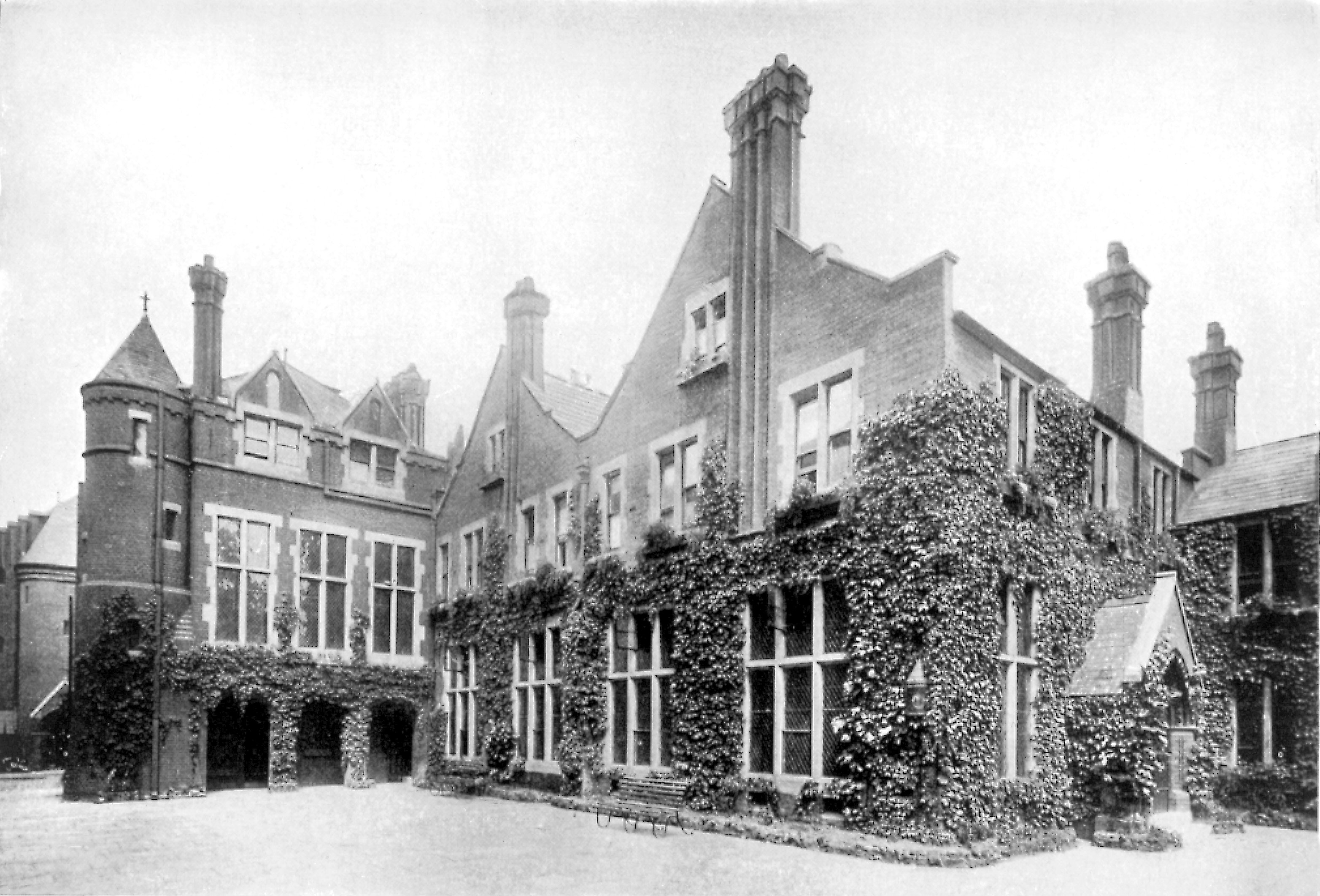
Toynbee Hall, in the east end of London, was established in 1884, named after an Oxford historian who had died the previous year.  In the 1880s there was a movement to address the poverty and appalling living conditions of many in the great cities.  Rev. Samuel Barnett, Toynbee Hall's founder had moved from a church in Mayfair to St Jude's, a derelict church in the east end in 1872 and it was here that Barnett and his wife Henrietta became drawn into community action.  The great idea of Toynbee Hall and the university settlement movement was to bring young undergraduates into the poorest communities to learn what life there was truly like, as a catalyst to change and to run schemes for education, welfare, better housing and even in time union organisation.

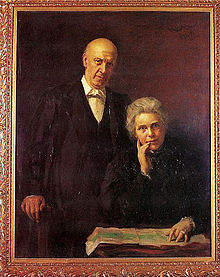
Samuel and Henrietta Barnett, painted by Hubert von Herkomer  
Barnett seems to have been determined to see his faith lead to practical action, he wished the people who came to the east end "to settle, that is, to learn as much as to teach, to receive as much as to give".  He wanted those making social policy to have knowledge of the problems faced by the people they were trying to help and his work had a huge impact.  Among people and projects he influenced were Cosmo Lang, later Archbishop of Canterbury, Charles Booth, who mapped London's poverty, future prime minister Asquith and William Beveridge, author of the eponymous report that led to the foundation of the NHS and welfare state.  Moreover for some men and women involvement in Toynbee Hall led to considerable social and educational advancement, the first scholarships for pupil teachers to go to Oxford or Cambridge were established in 1892.  While some involved in Toynbee Hall did very well such as J M Dent, bookbinder who became a publisher and established the Everyman series and Thomas Okey, a basket maker, who became first Professor of Italian at Cambridge.

I am not far through the book but already I find the breadth of the aims and vision of Toynbee Hall inspiring and slightly breath-taking.  Their work has a lot of relevance for today; sadly the problems they were tackling are still with us and getting worse, especially economic inequality.  It also makes me sad that these men and women fought so hard to get decent housing, health care etc. for all and we are now watching their work being dismantled or crippled by lack of funding.  So I would recommend this book as very readable and would commend it to any publisher who would consider republishing it.  Let us follow in their footsteps.

You can see the other entries for The Year in Books here
   

Thursday, 30 April 2015

The Year in Books: March catch up

As I have not yet decided on April's book yet I thought I would write about March's book (well, books) first, maybe something someone else has written about will inspire me?  My March choice is Nella Last's diaries, published (so far) as Nella Last's War, Nella Last's Peace and Nella Last in the 1950s, which I have been listening to as audio books.  Nella Last was a housewife from Barrow in Furness, married to Will who ran a joinery and shop fitting business, who wrote for Mass Observation from 1939 until a year or two before her death in 1968.  Her diary is the longest and most complete record in Mass Observation at around 12 million words and covers every aspect of her life - her marriage, her sons, Arthur and Cliff, her neighbours, friends, relations, voluntary work, housework, politics, news, her love of the Lakes and many other subjects.

Nella Last
The first volume, dealing with the war, was of great historical interest and provided a clear picture of day to day life in wartime, the hardships, losses, absences and bombs (Barrow suffered as badly in the Blitz as London) but above all the emotional state of ordinary men and women through the war.  Nella's diaries allow us to see behind the positive images of wartime propaganda to the petty arguments between tired, emotionally strained women, the fear that was so pervasive and to the huge efforts people went to in order to persevere and overcome.  In many ways the war was a better time for Nella than the years beforehand, when she had had mental breakdowns in part caused by her husband, who wanted her to be at home alone with him all the time and whose own mental health was none too good.  During the war she had definite reasons for being out of the house and meeting people, volunteering with the Red Cross, the WVS and for the local hospital.  Notable among her war work was running a very successful Red Cross charity shop to raise money to send Red Cross parcels to POWs.  In the post war years she and other women she knew desperately missed these activities and she frequently comments on how she could feel the four walls of her house closing in on her and wonders how she is going to occupy herself.


As I have already mentioned, Nella's husband was not an easy man and she is frank about her marriage, her fears and frustrations.  Neither enjoyed particularly good health, from Nella's descriptions of her physical health I began to suspect that today she would probably have been diagnosed with fibromyalgia, but while Nella's response was to try to keep going and be involved in the world, her husband's was quite the opposite.  This created an enormous tension between them, however, Nella does not indulge in self pity and there is nothing maudlin about the diaries.  She was a woman of a great many interests, quite apart from her writing, and I particularly enjoyed hearing about the dolls and toys she made to sell for charity; her skill at sewing must have been quite something.  The diaries are also punctuated with details of her housekeeping, shopping for food and the meals she was cooking.  Since rationing was in force for much of the period of the diaries published so far Nella writes about the troubles of supply, fairness, quality and the need for ingenuity with meals.

Some of the finest writing comes when she is writing about her trips to the nearby Lake District, where she had grown up on her grandmother's farm.  She writes lyrically of the beauty of the Lakes and of how their peace helped her and her husband.  Throughout Nella's record of her relations, neighbours and friends is a delight; she has an ear for the interesting snippet of conversation.  As I listened I grew genuinely fond of Nella and was very sad when the diaries ended; I am hoping there will be further books published, fingers crossed!

You can see the other books in the Year in Books here.

Monday, 29 September 2014

The Year in Books: September

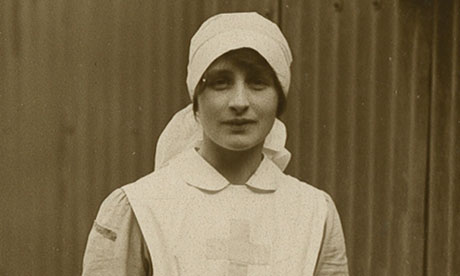
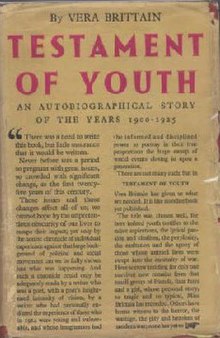
During the commemorations for the centenary of the First World War last month I decided that I should re-read Vera Brittain's memoir Testament of Youth sooner rather than later.  There was, of course, the usual trepidation one feels when approaching a book one first read as a teenager, but I am happy to say that it has more than held up to my memory of it as a magnificent book.  Vera Brittain left Somerville College, Oxford after one year to serve as a Voluntary Aid Detachment nurse (or VAD) during the war and the book covers her life from her birth in 1893 until 1925, when she married.  Testament of Youth is particularly valuable in giving an impression of the state of mind of the British in the run up to the war, throwing some light on why it was such a cataclysmic event and so very shattering to those who lived through it.


The first clue to this is given in the preface written by her daughter, the politician Shirley Williams, who writes that one reason we are so haunted by the war is, "the total imbalance between the causes for which the war was fought on both sides, as against the scale of the human sacrifice".  Brittain's account of the parts of the line, in the early part of the war, where neither side could see the point in killing one another and so had a small voluntary truce, shooting into the air and no man's land, is just one illustration of this point.  Why this war in particular has caught our collective imagination and is such an important part of our collective story is a question I have often pondered.  Our collective remembrance of war is still, a century on, so strongly shaped by the First World War, with our Remembrance Day poppies and our misty-eyed reading of Rupert Brooke and "age shall not weary them".


Brittain's book is a true help to understanding this question, by providing a solid pre-war background she is able to show how shattering the war was to her generation.  There seems to have been a deep complacency and belief in progress, running alongside a belief in the spiritual good of war, testing us and even (in a way that would seem shocking to a post-1945 audience) purging the population.  Brittain's account of attending speech day at her brother's public school in July 1914, with its military manoeuvres, shows the incredible militarism of the pre-war public schools, whence came most of the politicians and leaders of Britain.  The Arnoldian* curriculum of Officer Training Corps, sport and extensive study of Classics** lent itself to a romanticised, spiritual view of war; it is after all a small leap from the Pass at Thermoplyae to the poetry of the early part of the war.  However, these ideals failed to live up to the realities of trench warfare where death came at random from a shower of shells and bullets, killing indiscriminately the strong with the weak.

Testament of Youth has more than lived up to my teenage memories, it is an epic read, but not only is it worth reading, it is engrossing, so that you do not realise that you have somehow read a hundred, or two hundred pages.  According to the biography of Brittain at the beginning of Testament of a Generation (a collection of her and Winifred Holtby's journalism) she found the book extremely hard to write, but I am immensely glad she persevered.  I cannot recommend this book enough, do go and read it, it will enrich your understanding of the First World War immeasurably, but you will also spend time in splendid company.


Incidentally, reading Testament of Youth alongside Testament of a Generation has provided an interesting counter-point and each has cast some light on the other.  Aside from the impression that feminism has not advanced that far from the 1920s and that in politics little changes, each book has provided flashes of insight that have illuminated aspects of one another.  I was particularly interested to read an article discussing, in 1929, calls for the abolition of Remembrance Sunday, some apparently feeling that 11 years was quite sufficient to have remembered the war.  Likewise her horror at finding her children's nanny fixing a poppy on baby Shirley's cot for Remembrance Day throws light upon the gulf Brittain felt between her generation and the one that followed it; for her the poppy was a symbol of war and grief, but for her young nanny it was another "flag day" like any other.

You can see the rest of The Year in Books entries here

*Dr Arnold of Rugby School, whose reforms set the pattern for public schools in the 19th century and whose influence is still felt today, cf. Tom Brown's School Days
**Many of the texts studied were decidedly martial in flavour such as Homer, Thucydides and Caesar

Tuesday, 29 July 2014

Knitted Novelties

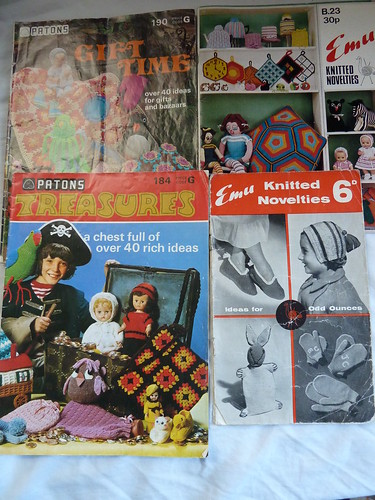
We all have our chosen mode of distraction when things are hard, some watch TV, read or play computer games: this past week or so I have been taking refuge in the world of vintage knitting patterns.  I have won two EBay auctions and had a lucky time in a charity shop; I am now forbidding myself to look at EBay again - it's a dangerous place!

P1040062

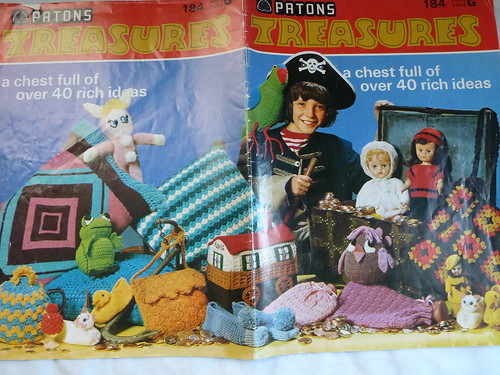
Knitted novelty or "Odd Ounce" books seem to appeal to me particularly, they are not only a source of knitting patterns ranging from useful to bizarre, they are also a piece of social history.  Knitting novelty items seems to go back as far as there were women with time on their hands for "fancy work", such as this fabulous knitted pineapple bag Franklin Habit has written about and the booklets I have been collecting are descendants of such patterns.  The proliferation of fund raising fĂȘtes and "fayres" increased the need for women, who mostly ran such events, to make these items.

P1040065

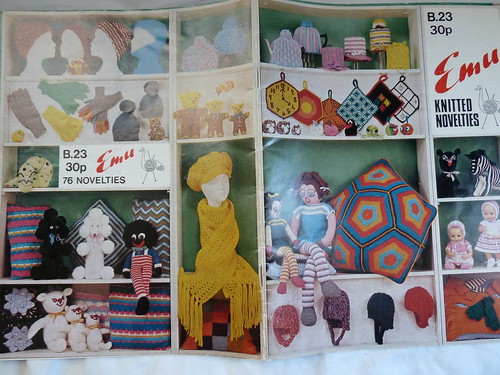
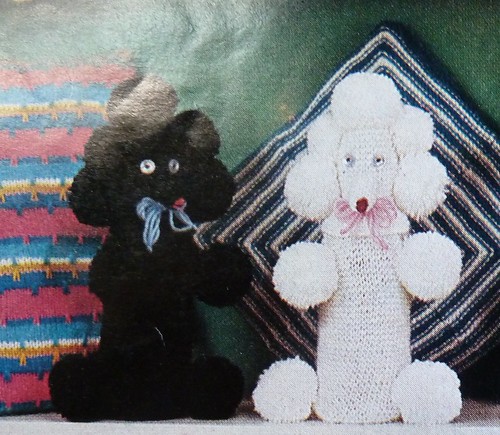
The majority of the items are of household utility, in a fancier form, such as tea cosies, cushions and pot holders in various guises.  Hats, scarves, gloves and bed-socks are popular items, all entering the category of "useful presents".  There are also toys and frequently dolls' clothes.  Then there things one could class as true novelty items, golf club covers, toilet roll covers and poodle bottle covers.

P1040063

Yet at the same time these booklets represent a something of the constriction of the lives of many women, unable to undertake paid work because of marriage.  While the absurdity of many of the items amuses me, there is also behind it a sense of the need to fill in empty hours, even in the comparatively liberated 1960s and 1970s (when the booklets in my collection were published), in lieu of more useful work.  This is not to disregard the money that was undoubtedly raised by the sale of such items for charity.

P1040064
I was particularly taken with the parrot when I spotted this one in a charity shop!

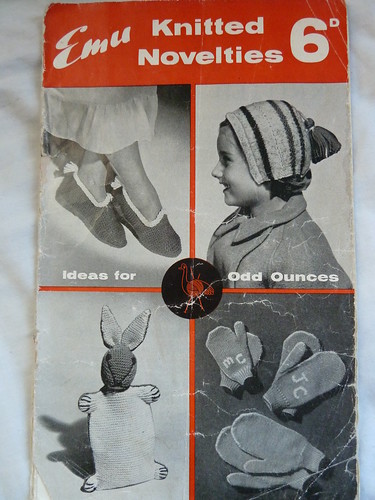
Some of the patterns I could see myself making, such as the rabbit hot water bottle cover on the front cover of the oldest booklet in my collection, others, such as the poodle bottle covers I will be giving a miss.  The current trend for vintage has even led some companies to republish some of these books, such as this one (even featuring a knitted pineapple tea cosy!) and this one from Patons, although many are still available relatively cheaply second hand.

P1040067

Apologies for the quality of photographs in this post - the paper is quite shiny on most of these booklets making it tricky.