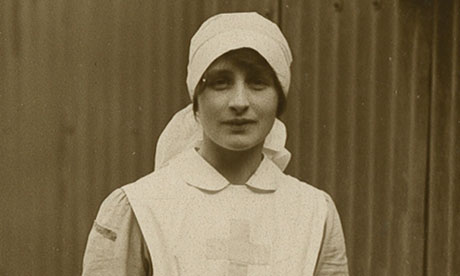
During the commemorations for the centenary of the First World War last month I decided that I should re-read Vera Brittain's memoir Testament of Youth sooner rather than later. There was, of course, the usual trepidation one feels when approaching a book one first read as a teenager, but I am happy to say that it has more than held up to my memory of it as a magnificent book. Vera Brittain left Somerville College, Oxford after one year to serve as a Voluntary Aid Detachment nurse (or VAD) during the war and the book covers her life from her birth in 1893 until 1925, when she married. Testament of Youth is particularly valuable in giving an impression of the state of mind of the British in the run up to the war, throwing some light on why it was such a cataclysmic event and so very shattering to those who lived through it.
The first clue to this is given in the preface written by her daughter, the politician Shirley Williams, who writes that one reason we are so haunted by the war is, "the total imbalance between the causes for which the war was fought on both sides, as against the scale of the human sacrifice". Brittain's account of the parts of the line, in the early part of the war, where neither side could see the point in killing one another and so had a small voluntary truce, shooting into the air and no man's land, is just one illustration of this point. Why this war in particular has caught our collective imagination and is such an important part of our collective story is a question I have often pondered. Our collective remembrance of war is still, a century on, so strongly shaped by the First World War, with our Remembrance Day poppies and our misty-eyed reading of Rupert Brooke and "age shall not weary them".
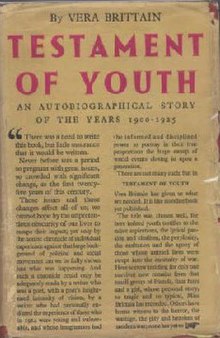
Brittain's book is a true help to understanding this question, by providing a solid pre-war background she is able to show how shattering the war was to her generation. There seems to have been a deep complacency and belief in progress, running alongside a belief in the spiritual good of war, testing us and even (in a way that would seem shocking to a post-1945 audience) purging the population. Brittain's account of attending speech day at her brother's public school in July 1914, with its military manoeuvres, shows the incredible militarism of the pre-war public schools, whence came most of the politicians and leaders of Britain. The Arnoldian* curriculum of Officer Training Corps, sport and extensive study of Classics** lent itself to a romanticised, spiritual view of war; it is after all a small leap from the Pass at Thermoplyae to the poetry of the early part of the war. However, these ideals failed to live up to the realities of trench warfare where death came at random from a shower of shells and bullets, killing indiscriminately the strong with the weak.
Testament of Youth has more than lived up to my teenage memories, it is an epic read, but not only is it worth reading, it is engrossing, so that you do not realise that you have somehow read a hundred, or two hundred pages. According to the biography of Brittain at the beginning of Testament of a Generation (a collection of her and Winifred Holtby's journalism) she found the book extremely hard to write, but I am immensely glad she persevered. I cannot recommend this book enough, do go and read it, it will enrich your understanding of the First World War immeasurably, but you will also spend time in splendid company.
Incidentally, reading Testament of Youth alongside Testament of a Generation has provided an interesting counter-point and each has cast some light on the other. Aside from the impression that feminism has not advanced that far from the 1920s and that in politics little changes, each book has provided flashes of insight that have illuminated aspects of one another. I was particularly interested to read an article discussing, in 1929, calls for the abolition of Remembrance Sunday, some apparently feeling that 11 years was quite sufficient to have remembered the war. Likewise her horror at finding her children's nanny fixing a poppy on baby Shirley's cot for Remembrance Day throws light upon the gulf Brittain felt between her generation and the one that followed it; for her the poppy was a symbol of war and grief, but for her young nanny it was another "flag day" like any other.
You can see the rest of The Year in Books entries here
*Dr Arnold of Rugby School, whose reforms set the pattern for public schools in the 19th century and whose influence is still felt today, cf. Tom Brown's School Days
**Many of the texts studied were decidedly martial in flavour such as Homer, Thucydides and Caesar
Showing posts with label remembrance. Show all posts
Monday, 29 September 2014
Sunday, 10 November 2013
Remembrance
Today is Remembrance Sunday, a day I approach with mixed feelings, as I had more ancestors in the German and Austrian armies than the British in the first world war, my maternal grandparents being of German, Austrian and Czech extraction. My paternal grandfather's brother fought in and survived the first war and his sisters nursed, but it is still a day that makes me feel my mixed heritage more keenly than normal. Although it is a day to remember the dead of all nations and of all wars, the first and second world wars do tend to dominate in this country, partly, the cynical historian in me thinks, because we won both wars, but also because Remembrance Sunday was founded in response to the widespread grief following the first war.
However, my ambivalent feelings are increased because Remembrance Sunday seems to be focussed on the soldiers who fell in the wars and of course should be remembered and mourned. But meanwhile the civilians, who also died in great numbers, seem forgotten. I feel this personally as somewhere in the region of three-quarters of my paternal grandfather's family died or disappeared as civilians, whole families vanishing in their entirety, in the Holocaust during the second world war.

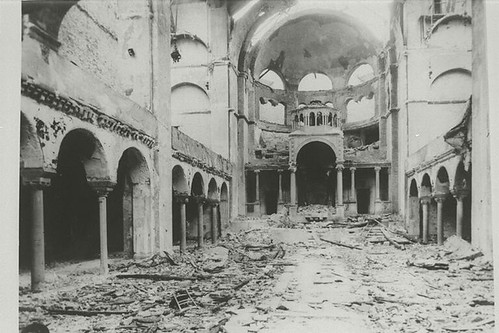
From a synagogue destroyed in Berlin on Kristallnacht Flickr Commons
This year Remembrance Day falls on the 75th anniversary of Kristallnacht when the Nazis attacked Jewish people, homes, businesses and synagogues in Germany and Austria in reprisal for the killing of a German diplomat in Paris by a Jewish youth. Ninety one people died and 30,000 were sent to concentration camps, but it marked the beginning of the Nazi "final solution". My grandfather and his mother were lucky, they got out, my grandfather on the last train he could legally have got; his father and most of the rest of his family were less lucky.

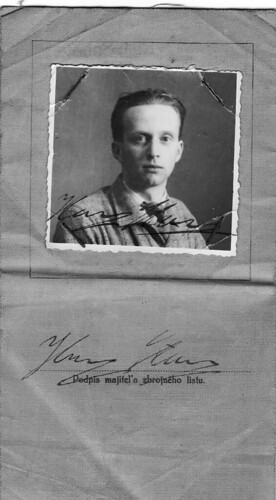
My grandfather in his 1935 Czech passport
These events and the sense of loss they created have cast a long shadow across my family. We need to remember all who have died or suffered loss on all sides, and never to allow remembrance to become glorification of war. Although on the last point I think this ex-serviceman, writing in the Guardian puts things better than I can. When I hear the jingoistic writing from the beginning of the first war repeated again and again by politicians, the media, social media, as part of remembrance day I shudder inwardly. One might as well repeat the last line of Wilfred Owen's Dulce et decorum est and omit the all important context, of "the old lie".
And for the future? We need to keep talking, keep telling the stories, try to stop ourselves repeating the same mistakes again and again. We need to make sure our remembrance does not become justification for current or future war and work and pray for peace and reconciliation and healing.
Father forgive us our follies, grant us peace, comfort those who mourn, help us to love mercy and seek justice and walk humbly before you.
I leave you with Michael Tippett's Oratorio A Child of Our Time, which was written in 1939 in response to Kristallnacht.
However, my ambivalent feelings are increased because Remembrance Sunday seems to be focussed on the soldiers who fell in the wars and of course should be remembered and mourned. But meanwhile the civilians, who also died in great numbers, seem forgotten. I feel this personally as somewhere in the region of three-quarters of my paternal grandfather's family died or disappeared as civilians, whole families vanishing in their entirety, in the Holocaust during the second world war.

From a synagogue destroyed in Berlin on Kristallnacht Flickr Commons
This year Remembrance Day falls on the 75th anniversary of Kristallnacht when the Nazis attacked Jewish people, homes, businesses and synagogues in Germany and Austria in reprisal for the killing of a German diplomat in Paris by a Jewish youth. Ninety one people died and 30,000 were sent to concentration camps, but it marked the beginning of the Nazi "final solution". My grandfather and his mother were lucky, they got out, my grandfather on the last train he could legally have got; his father and most of the rest of his family were less lucky.

My grandfather in his 1935 Czech passport
These events and the sense of loss they created have cast a long shadow across my family. We need to remember all who have died or suffered loss on all sides, and never to allow remembrance to become glorification of war. Although on the last point I think this ex-serviceman, writing in the Guardian puts things better than I can. When I hear the jingoistic writing from the beginning of the first war repeated again and again by politicians, the media, social media, as part of remembrance day I shudder inwardly. One might as well repeat the last line of Wilfred Owen's Dulce et decorum est and omit the all important context, of "the old lie".
And for the future? We need to keep talking, keep telling the stories, try to stop ourselves repeating the same mistakes again and again. We need to make sure our remembrance does not become justification for current or future war and work and pray for peace and reconciliation and healing.
Father forgive us our follies, grant us peace, comfort those who mourn, help us to love mercy and seek justice and walk humbly before you.
I leave you with Michael Tippett's Oratorio A Child of Our Time, which was written in 1939 in response to Kristallnacht.
Labels:
family,
history,
identity,
Jew,
Kristallnacht,
music,
personal,
remembrance,
war
Subscribe to:
Posts (Atom)