Sunday, 30 November 2014

First Sunday in Advent

This Advent I thought I would mark the Sundays of Advent by posting some of my favourite Christmas poems, one on each Sunday, although the odd poem may appear on other days as well.  I decided to start with an old favourite, Christmas by John Betjeman, which masterfully combines Christmas ancient and modern.  I was introduced to this poem when a couple of us read some of it at a prep school carol concert at the local church and have loved it ever since.

Christmas by John Betjeman

The bells of waiting Advent ring,
The Tortoise stove is lit again
And lamp-oil light across the night
Has caught the streaks of winter rain.
In many a stained-glass window sheen
From Crimson Lake to Hooker's Green.

The holly in the windy hedge
And round the Manor House the yew
Will soon be stripped to deck the ledge,
The altar, font and arch and pew,
So that villagers can say
'The Church looks nice' on Christmas Day.

Provincial public houses blaze
And Corporation tramcars clang,
On lighted tenements I gaze
Where paper decorations hang,
And bunting in the red Town Hall
Says 'Merry Christmas to you all'

And London shops on Christmas Eve
Are strung with silver bells and flowers
As hurrying clerks the City leave
To pigeon-haunted classic towers,
And marbled clouds go scudding by
The many-steepled London sky.

And girls in slacks remember Dad,
And oafish louts remember Mum,
And sleepless children's hearts are glad,
And Christmas morning bells say 'Come!'
Even to shining ones who dwell
Safe in the Dorchester Hotel.

And is it true? and is it true?
The most tremendous tale of all,
Seen in a stained-glass window's hue,
A Baby in an ox's stall?
The Maker of the stars and sea
Become a Child on earth for me?

And is it true? For if it is,
No loving fingers tying strings
Around those tissued fripperies,
The sweet and silly Christmas things,
Bath salts and inexpensive scent
And hideous tie so kindly meant.

No love that in a family dwells,
No carolling in frosty air,
Nor all the steeple-shaking bells
Can with this single Truth compare -
That God was Man in Palestine
And lives to-day in Bread and Wine.
P1040324

Friday, 28 November 2014

The Year in Books: November

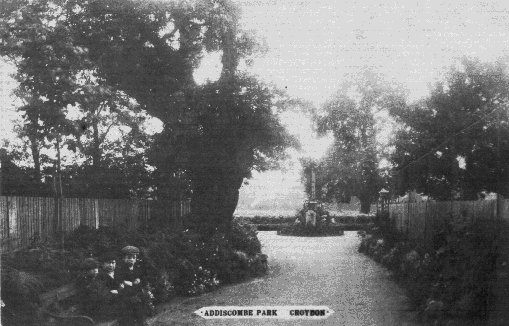
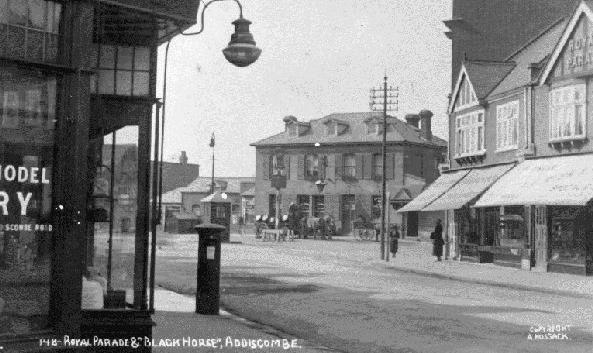
This month's book, The Dreaming Suburb by R F Delderfield, is one set locally to wear I live, which is always a matter of great curiosity, to see a place one knows at a different time and through different eyes.  The novel is set at the far edge of Addiscombe, about a mile and a half east of central Croydon, then the far edge of London, where a street of suburban houses hit the countryside.  Although sadly and predictably swathes of suburbs have covered much of that countryside since.  The action opens as the First World War finished and followed various residents of the avenue through to the beginning of the second war, via the vicissitudes of the intervening years.

R F Delderfield
Delderfield writes in defence of the suburbs, already by the 1940s (when he wrote the book) denigrated, arguing that residents of suburbs have dreams and worries, hopes and fears, just as a city or country dweller has.  It is clear that he enjoyed his time living in Addiscombe as a child and that he retained vivid memories of the place.  He has changed very little about his descriptions, depicting Addiscombe almost exactly as she was and is, almost street by street.

"The Rec" 1918
This is not a great work of literature but it is a pleasant, relaxing and engaging read: the characters are engaging and "real" and he is skillful at weaving a story through their various lives and the events that surround them.  Throughout there is a definite sense of how people react in their various ways to the history that surrounds them, in this case things like the General Strike and the Munich crisis.  The change in the suburb is charted too as the great houses decay and streets of terraces fill their grounds.

"The Lower Road"
Croydon as a whole has a bad reputation and a low self esteem (if one can say that of a place?) these days and so it is lovely to see a time in her past when this was not so.  A lot of these problems have come about from appalling decisions made in the second half of the twentieth century and which continue today.  But Croydon does have a proud past and we should celebrate it more, from the Old Palace, regularly visited by kings and queens, especially Elizabeth I, to the college of the East India Company and the world's first international airport, which saw Amy Johnson return from her solo flight to Australia.  Croydon has other literary claims to fame, for example, at the time that Delderfield lived in Addiscombe, D H Lawrence was living a few streets away, teaching at a nearby school and beginning his literary career and in the previous century Arthur Conan Doyle had lived a few miles away in South Norwood.

But to get back to The Dreaming Suburb, I would recommend it as a gentle, well written book, which captures a time in our life as a nation through the lens of an ordinary street of ordinary people, a perspective different to most histories.

Photographs of Addiscombe past from here

To see the other entries in The Year in Books click here

Monday, 17 November 2014

Christian Community and the Sick

When I first heard about the Community of St Anselm, the new community of prayer being established at Lambeth Palace for people aged 20-35 to “spend a year in God's time”, I was terribly excited and ready to sign up right away. I have been increasingly interested in the ideas around community for some years now and the practises of regular prayer through the day, although I have been less successful always in establishing that discipline at home on my own. It sounds like a fantastic opportunity to grow, learn and experience God. Most of all I thought, “imagine not being lonely for a whole year, not being a Christian alone, being with other Christians”. Being sick, unable to work and coming from a non-Christian family has been intensely lonely, both from a general point of view and from a specifically Christian point of view.

But then reality kicked in, the reality that this community needed energetic people, it was there in the language of discipline, rigour, discomfort and hard work. The reality that someone like me would never keep up for a week, let alone a year. The reality that being around people can be draining. The reality that being chronically ill has made me something of a hermit, unable to be around people, too tired to take part in so many things, not a willing hermit, but one because of circumstance.

My natural reaction to this is to be thoroughly fed up at seeing yet another opportunity go out of my reach, being shut out again because I have no energy to be busy and active, feeling useless yet again. Yet although these feelings are valid and need expressing, it does not have to end here does it? So I cannot be part of this community? It does not mean that I and others like me are shut out of all expressions of community?

I hate to think of there being others out there like me, each isolated from the wider church, feeling outside and being unable to connect with one another. Although things are easier now, I have been through times of intense isolation and still feel too isolated from and out of step with other Christians my own age, and I cannot be the only person in a similar situation? Beginning to read Dietrich Bonhoeffer's Life Together has provided a challenging view of community and I have been especially struck by his view that to live in community with our brothers and sisters in Christ is a privilege.

“So between the death of Christ and the Last Day it is only by a gracious anticipation of the last things that Christians are privileged to live in visible fellowship with other Christians. It is by the grace of God that a congregation is permitted to gather visibly in this world to share God's Word and sacrament. Not all Christians receive this blessing. The imprisoned, the sick, the scattered lonely, the proclaimers of the Gospel in heathen lands stand alone. They know that visible fellowship is a blessing. They remember, as the Psalmist did, how they went 'with the multitude... to the house of God, with the voice of joy and praise, with a multitude that kept holyday' (Ps. 42.4). But they remain alone in far countries, a scattered seed according to God's will. Yet what is denied them in actual experience they seize upon more fervently in faith.”

So community is not only a privilege, but also a prophetic way of living that foretells the way things will be on the new earth. However, as we are still being remade and are not yet fully perfected, living out this calling is a tremendous challenge as we need to be able to leave behind our own needs, priorities and concerns in order to love one another and live together in harmony. Do the demands that illness make upon my body leave enough energy and strength for this challenge?

In myself certainly no, but in God's grace and with His help who knows what may be possible, always bearing in mind that as things stand I am not healed. Therefore maybe my challenge is to consider other means of living in a degree of community, looking for a way for people like me, who are shut out because of sickness, to come together for fellowship, be it virtual or visible? Prayer is one of the few things you can still do when you have next to no energy, so there is no reason for the sick to be shut out of Archbishop Justin's call to prayer, but the challenge is to find ways of enjoying the privilege and blessing of praying with others. Paradoxically this illness has been the means by which I have learnt to value prayer and to rely on God in prayer, because I have fewer of my own resources. I have learnt that prayer takes incredible perseverance, some days just concentrating enough is a massive struggle and of course there are days when the prayer is the simple, primeval, “help!” and no more. God is gracious and helps me when I ask Him to help me with prayer and reading the Bible. But being able to come together with other Christians daily for prayer continues to be something I dream about.


It seems, therefore, that I will be sitting out the Community of St Anselm, but perhaps it can prompt me to fresh thinking about community and its different forms? And of course I can pray, for the Community itself, for the wider church and that we can find a way for people like me to take part in a community of fellowship and encouragement, virtual and face to face. I have no idea what form this will take or what it will look like, or even if it will happen, but for now I will keep reading, praying, hoping and waiting on God.

Sunday, 2 November 2014

H-H-Happy Birthday Hancock's Half Hour

Today marks 60 years since the first ever episode of my very favourite comedy show, Hancock's Half Hour, was broadcast.  I first heard Hancock on a tape belonging to my parents and became hooked once BBC 7, now BBC Radio 4 Extra, started.  Hancock even featured on the opening night of BBC 7 and I remember sitting beside my Dad's new digital radio laughing and laughing.

Tony Hancock
The show starred Tony Hancock, playing a version of himself, living first in a shared flat and then later at "23 Railway Cuttings, East Cheam", with a group of friends who over the years included Bill Kerr, Sid James, Andre Melly and Hattie Jacques.  Kenneth Williams was also a regular, playing a wide range of characters and making full use of his vocal talents.  Hancock is a character whose ideas of himself do not always live up to reality and who shares traits with Mr Pooter and Captain Mainwaring; although he is less pompous he is still full of pretensions.

Despite all the radio episodes being recorded in the 1950s the show remains fresh and funny; the only clues to its age being some of the topical references and prices.  The clearest demonstration of this freshness is that in the re-recorded lost episodes that Radio 4 have just made they only had to change half a line in five episodes.  Writers Alan Galton and Ray Simpson picked up on trends in the contemporary theatre, producing an episode in which Hancock is starring in a play called Look Back in Hunger, a reference to John Osbourne's Look Back in Anger and the famous Sunday Afternoon episode makes reference to Beckett's Waiting for Godot.  The only thing that spoilt the show was Hancock's increasing jealousy of his co-stars, which meant that by the time the last television episodes were made none of his original co-stars were left in the show, a true loss.  The early episodes where his co-stars are allowed more laughs are much funnier for it.

L-R Kenneth Williams, Tony Hancock, Bill Kerr and Sid James
I have listened to an episode of Hancock every week for years and have missed it lately while it has been off the air on Radio 4 Extra.  However, to mark the anniversary (and help with my withdrawal symptoms!) the BBC have, as I mentioned earlier, re-recorded five lost episodes, the first of which went out on Friday - you can hear them here.  It was truly brilliant and they "got" most of the voices perfectly.  Then in addition three hours of Hancock related programming went out on Radio 4 Extra yesterday - which you can hear here.

Get listening, you won't regret it!  Anyone else into vintage radio comedy out there?

P.S. For vintage comedy geeks there is an amazing episode of The Men From The Ministry available here, in which the cast of Much Binding in the Marsh, the show in which Richard Murdoch, the co-star, really made his name in the 1940s, appear.  It's truly delightful, very funny and according to my Dad (a retired civil servant) an accurate picture of civil service life.

P.P.S. There's a six part series on the history of radio comedy 1975-2005 on Radio 4 started on Saturday.  It's entertaining but I do wish they had started earlier.

Friday, 31 October 2014

The Year in Books: October

This month's reading has been somewhat theological in nature; Surprised by Scripture by Tom Wright, former Bishop of Durham, has particularly stood out.  It is a collection of essays based on talks he has given, mainly in America and makes an excellent introduction to his theology and thinking.  Wright has placed an emphasis on reading the Bible, especially the New Testament, within its own original context and then attempts to relate the Bible to today.  Consequently he looks at the thinking which has led us to see the Bible in a particular way, especially the Reformation and the 18th century Enlightenment and the "surprise" in the title refers to the difference between what we may think the Bible says on a subject and what it truly says.


Although it may sound like a very heavy read its original lecture format has made it more readable and means that each chapter is relatively short.  Wright takes on the enlightenment thinking, particularly the ideas of Epicureanism - that God created the world and then left it to itself for example - and takes these ideas back to the Bible to show that they have little or no biblical basis.  Throughout he does not shrink from taking on difficult subjects such as politics, the environment and the role of women in the church - a chapter I found very freeing as Wright went back into the biblical text and its original context.

One of the biggest surprises of the book so far for me was the chapter entitled, "Jesus is coming - plant a tree!", about heaven and earth, explaining how God is not going to be rescuing us from this wicked earth and spiriting us away to heaven, but that Jesus is coming again to renew the earth.  Therefore he argues that what we do here and now matters for the future, especially how we treat our planet, which is not all bad, although "subject to futility" (Romans 8.20).  At the centre of this chapter is a fresh look at Romans 8.

Durham Cathedral

I cannot recommend this book enough, indeed I have been going around telling everyone to read it!  It is not the quickest read, but worth going through and giving consideration.  Should you wish to try one or two of the chapters before committing to buying chapter six, "9/11, Tsunamis and the New Problem of Evil", is available here, more articles by Tom Wright are available here and there is an interesting interview with Tom Wright here.  Get reading, stretch your brain and be surprised!

You can see the other entries in this month's Year in Books here

Friday, 10 October 2014

Some Vintage Knitting Resources

In my journeys around the internet I have discovered some vintage knitting patterns and resources that I thought worth sharing.  Although I knew about Trove*, the free online archive of Australian newspapers and magazines, which contains many free patterns, it was only recently that I came across the collection of digitised knitting books put up by the State Library of Victoria, Australia.  The Australians truly are good to us.

cover1

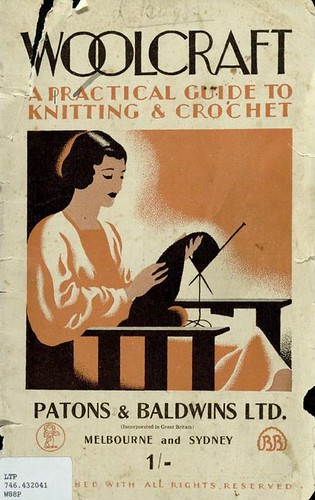
Among the books I have found in the State Library's online collection is the 1933 edition of Woolcraft, a thoroughly useful publication containing a wide range of patterns, particularly strong on socks and baby clothes.  I have started gradually adding the patterns to Ravelry and they can be seen here; it is going to take me a while to get them all up there.  Incidentally the 1915 edition is among a range of books available here.

My personal favourite is the 1948 Woman's Knitting Book which features this dashing reindeer jumper on the cover, which unusually for the period is fully charted.  You can see the woman's role in society in flux between the wartime working women, as seen in a knitted suit, "designed primarily for the business girl or traveller" and the 1950s ideal housewives, as seen in a brightly smiling advert for "Raco Aluminium Ware", "Bright Kitchens Happy Homes".  There is a good range of patterns for all the family, including a man's skiing jumper, baby's layette, gloves, cardigans and socks.  I have added the front cover jumper to Ravelry as I thought it might appeal to those looking for a retro Christmas jumper.

woman's knitting book

Given the age of the collection it is unsurprising that there are various booklets of "service woollies" or "knitted comforts", the austerely covered booklet P&B (Patons and Baldwins) Knitting Made Easy from 1941 is part pattern catalogue, with tips on knitting for the forces and a handful of patterns.  There is also a booklet from the Australian Comforts Fund dating from 1940 and a booklet from department store Coles, Knitting for the Forces.

The last item I will mention for today is the Viyella Nursery Book, listed as dating from the 1940s and containing a great many patterns for babies and children up to five years old.  Some of the patterns are perhaps knitted with finer yarns than we might use today, but a little adaptation could make bigger garments.  There are a great many other baby booklets such as From 2 to 5: 11 smart and practical new styles, Smith's Ideal Baby knits and Toddler knits and Baby Knitting 6 months - 2 years.  Also included are a great many baby books by a lady called Ella Allan but I shall go into them in another post.

I hope you enjoy these resources as much as I have been.

P.S. My crochet blanket is making slow but steady progress.
P1040286

*There is a Trove group on Ravelry whose members have been doing an amazing job of locating patterns and adding them to the pattern database.

Monday, 29 September 2014

The Year in Books: September

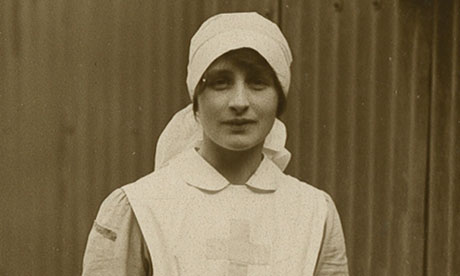
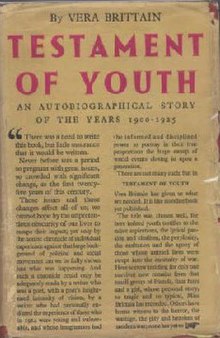
During the commemorations for the centenary of the First World War last month I decided that I should re-read Vera Brittain's memoir Testament of Youth sooner rather than later.  There was, of course, the usual trepidation one feels when approaching a book one first read as a teenager, but I am happy to say that it has more than held up to my memory of it as a magnificent book.  Vera Brittain left Somerville College, Oxford after one year to serve as a Voluntary Aid Detachment nurse (or VAD) during the war and the book covers her life from her birth in 1893 until 1925, when she married.  Testament of Youth is particularly valuable in giving an impression of the state of mind of the British in the run up to the war, throwing some light on why it was such a cataclysmic event and so very shattering to those who lived through it.


The first clue to this is given in the preface written by her daughter, the politician Shirley Williams, who writes that one reason we are so haunted by the war is, "the total imbalance between the causes for which the war was fought on both sides, as against the scale of the human sacrifice".  Brittain's account of the parts of the line, in the early part of the war, where neither side could see the point in killing one another and so had a small voluntary truce, shooting into the air and no man's land, is just one illustration of this point.  Why this war in particular has caught our collective imagination and is such an important part of our collective story is a question I have often pondered.  Our collective remembrance of war is still, a century on, so strongly shaped by the First World War, with our Remembrance Day poppies and our misty-eyed reading of Rupert Brooke and "age shall not weary them".


Brittain's book is a true help to understanding this question, by providing a solid pre-war background she is able to show how shattering the war was to her generation.  There seems to have been a deep complacency and belief in progress, running alongside a belief in the spiritual good of war, testing us and even (in a way that would seem shocking to a post-1945 audience) purging the population.  Brittain's account of attending speech day at her brother's public school in July 1914, with its military manoeuvres, shows the incredible militarism of the pre-war public schools, whence came most of the politicians and leaders of Britain.  The Arnoldian* curriculum of Officer Training Corps, sport and extensive study of Classics** lent itself to a romanticised, spiritual view of war; it is after all a small leap from the Pass at Thermoplyae to the poetry of the early part of the war.  However, these ideals failed to live up to the realities of trench warfare where death came at random from a shower of shells and bullets, killing indiscriminately the strong with the weak.

Testament of Youth has more than lived up to my teenage memories, it is an epic read, but not only is it worth reading, it is engrossing, so that you do not realise that you have somehow read a hundred, or two hundred pages.  According to the biography of Brittain at the beginning of Testament of a Generation (a collection of her and Winifred Holtby's journalism) she found the book extremely hard to write, but I am immensely glad she persevered.  I cannot recommend this book enough, do go and read it, it will enrich your understanding of the First World War immeasurably, but you will also spend time in splendid company.


Incidentally, reading Testament of Youth alongside Testament of a Generation has provided an interesting counter-point and each has cast some light on the other.  Aside from the impression that feminism has not advanced that far from the 1920s and that in politics little changes, each book has provided flashes of insight that have illuminated aspects of one another.  I was particularly interested to read an article discussing, in 1929, calls for the abolition of Remembrance Sunday, some apparently feeling that 11 years was quite sufficient to have remembered the war.  Likewise her horror at finding her children's nanny fixing a poppy on baby Shirley's cot for Remembrance Day throws light upon the gulf Brittain felt between her generation and the one that followed it; for her the poppy was a symbol of war and grief, but for her young nanny it was another "flag day" like any other.

You can see the rest of The Year in Books entries here

*Dr Arnold of Rugby School, whose reforms set the pattern for public schools in the 19th century and whose influence is still felt today, cf. Tom Brown's School Days
**Many of the texts studied were decidedly martial in flavour such as Homer, Thucydides and Caesar